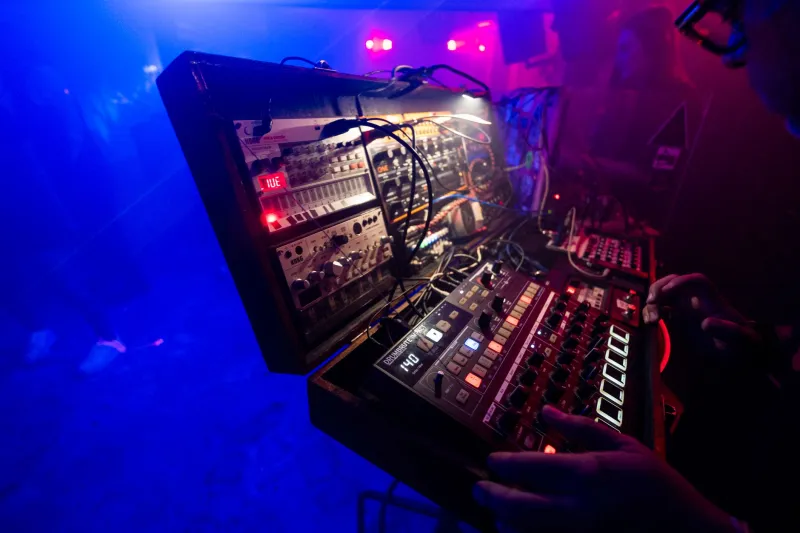
Prime Time on the Cheap: The 10 PM Slot Is the Best Career Move Nobody in America Is Taking
Photo: Ken Lund from Reno, Nevada, USA, CC BY-SA 2.0, via Wikimedia Commons
Ask any club promoter in America to describe the 10 PM to midnight window and you'll hear some version of the same answer: it's the warm-up. It's the filler. It's the slot you give to the local act as a favor, or to the headliner's friend who needed a booking. It's the part of the night that exists primarily to fill dead air before the main event.
Ask the DJs who've been quietly building cult followings by owning that exact window, and you'll hear something very different.
"That slot changed my career," says Los Angeles-based DJ and producer Demi Vásquez, who spent two years holding down a weekly 10-to-midnight residency at a Silver Lake venue before her name started appearing on festival lineups. "Everyone was focused on who was headlining. Nobody was paying attention to me, which meant I could do whatever I wanted. I built an entire sound in that room with zero pressure."
The Invisible Window
American club culture has a clear hierarchy, and the 10 PM to midnight slot sits in an awkward middle space. It's too late to be ignored entirely, but too early to carry the weight of the night's climax. Promoters fill it without much thought. Headliners don't think about it at all. And for most emerging DJs, it feels like a consolation prize — proof that you're not quite ready for the real thing.
But that framing misses something fundamental about what actually happens in a room during those two hours. The crowd is arriving. They're sober enough to listen carefully. They're in the process of deciding how they feel about the night, which means they're open — genuinely open — to being shaped by whatever the DJ gives them. The headliner, by contrast, inherits a room that's already been primed, already committed, already three drinks in and ready to go wherever the music takes them.
The 10 PM DJ is working with raw material. That's harder, but it's also more powerful.
The Case Studies Nobody's Talking About
Vásquez isn't the only one who figured this out. Across the country, a loose constellation of DJs has been leveraging the early slot to build something more durable than a single standout performance.
In Atlanta, DJ and producer Kofi Mensah spent eighteen months as the opening act at a Ponce de Leon Avenue venue before his sets started drawing people specifically for his slot — not the headliner. "I noticed after about six months that some of the same faces kept showing up right at 10," he says. "They weren't there for the headliner. They were there for what I was doing. That was the moment I realized I had something."
Mensah's approach was deliberate: he used the early slot to experiment with tempo structures and genre combinations he couldn't have gotten away with in a headliner context. The lower stakes created a laboratory. The laboratory produced a sound. The sound produced a following.
In New York, a similar pattern has emerged at several Brooklyn venues where the 10 PM slot has become something of an underground proving ground. Promoters at these spots have noticed that certain early-slot DJs are now drawing as many ticket sales as the acts they're opening for — a reversal that would have seemed unlikely just a few years ago.
Why the Stakes Feel Lower (and Why That's the Point)
The psychological advantage of the early slot is easy to underestimate. When you're not the headliner, nobody's expecting perfection. A bold experiment that doesn't quite land won't define your night — it'll just be a moment that passed. The headliner doesn't have that luxury. Every choice they make is being judged against the weight of expectation.
This asymmetry means the 10 PM DJ can take creative risks that a headliner simply can't afford. Over time, those risks compound. The DJ who experiments every week for a year develops a more distinctive voice than the DJ who plays it safe every time the stakes are high.
"The headliner slot sounds like the goal, but it's actually a constraint," says Chicago promoter and venue consultant Ray Tillman, who books talent for two mid-size clubs on the North Side. "You have to deliver a certain thing. The opening DJ has no such obligation. I've watched more interesting careers get built in the early slot than anywhere else."
How to Actually Leverage It
If you're sitting on a recurring 10 PM booking and treating it like a stepping stone to something better, here's a reframe worth considering: this slot is the something better, if you're willing to treat it that way.
The first move is consistency. A one-off early set doesn't build anything. A weekly or monthly presence in the same room — same time, same venue — starts to create an expectation in the audience's mind. People begin to plan around you. That's the foundation of a real following.
The second move is documentation. Record every set. Clip the best moments. The early slot gives you content that shows your range and your willingness to take risks — exactly the kind of material that gets you noticed by promoters and labels who are looking for something that doesn't sound like everything else.
The third move is ownership. Don't think of yourself as the warm-up. Think of yourself as the person who sets the emotional tone for the entire night. That's not a lesser role — it's a different one, and in many ways a more technically demanding one.
The 10 PM window is wide open right now. Most of the competition is looking past it, eyes fixed on the headliner slot they haven't earned yet. The DJs who figure out what's actually available in those two hours are building something that a single peak-time performance could never give them: a room that shows up for them, every time, because they showed up for the room first.