Why Some DJ Transitions Hit Different: The Physics and Psychology Behind a Perfect Mix
You've felt it before. That moment on the dance floor when one track slides into the next so smoothly that your brain barely registers the swap — but your body absolutely does. Your feet stay planted, your arms go up, and the energy in the room quietly doubles. You've also felt the opposite: that jarring, stomach-dropping lurch when two songs collide wrong, the tempo suddenly off, the bass frequencies fighting each other like two people trying to walk through the same doorway at once.
The difference between those two experiences isn't luck. It's craft. And it turns out, it's also science.
Beat-Matching Is Just the Beginning
Most people who've been around DJ culture for more than five minutes know that beat-matching — syncing the BPM of two tracks so their kick drums align — is the foundation of any clean transition. But treating beat-matching as the finish line is like saying a good sentence just needs correct spelling. It's necessary, but nowhere near sufficient.
"Beginners think once the beats line up, the work is done," says Marcus Webb, a Chicago house DJ who's been holding down residencies across the Midwest for over a decade. "But the groove lives in the micro-timing. Two tracks can be perfectly synced at 128 BPM and still feel like they're fighting each other because the swing is different, because the transients hit at slightly different places within the beat."
 Photo: Marcus Webb, via www.now14.co.il
He's talking about something audio engineers call transient shaping — the way the attack and decay of a kick drum or snare defines its rhythmic feel. A punchy, front-loaded kick from a classic Detroit techno record is a completely different animal from the rounder, slightly delayed thump of a modern melodic house track, even if both sit at exactly the same tempo. When you layer them carelessly, the result is a kind of rhythmic dissonance that dancers feel in their bodies before they consciously process it.
The fix? Webb recommends spending time in your library categorizing tracks not just by BPM and key, but by groove feel — whether a track is straight, swung, or somewhere in between. Blending tracks with similar groove profiles creates what he calls "invisible transitions," where the crowd never gets a chance to disengage.
The EQ Is Your Volume Knob for Frequency Layers
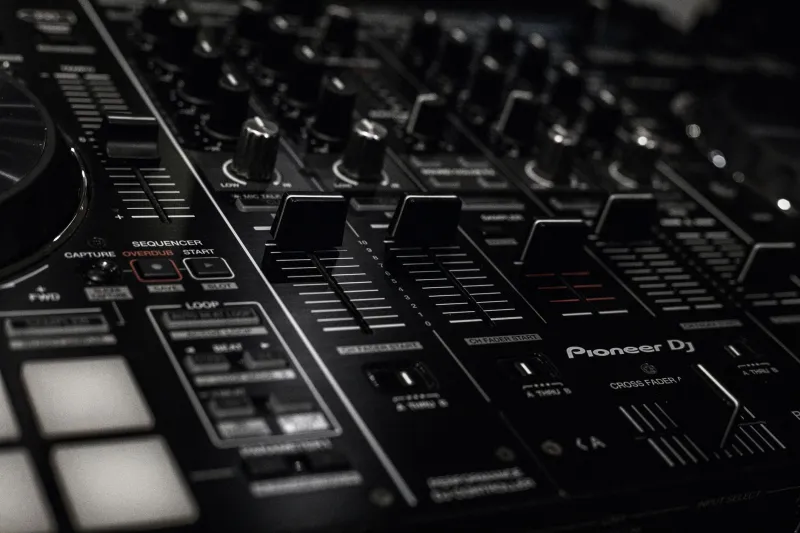
If beat-matching is the skeleton of a good transition, EQ sculpting is the muscle tissue. The three-band EQ on virtually every DJ mixer — low, mid, high — lets you control which frequency layers of each track the audience hears at any given moment. Mastering this tool is where transitions stop being technical exercises and start becoming musical decisions.
The classic technique is the bass swap: as Track B fades in, you keep its low frequencies cut all the way down while Track A still carries the bottom end. Gradually, you pull up the bass on Track B while simultaneously cutting it from Track A. Done right, the floor never loses its rhythmic anchor — the kick drum energy transfers cleanly from one record to the next like a relay baton.
"The biggest mistake I hear from newer DJs is letting two bass lines run simultaneously," says DJ Solenne, a Brooklyn-based selector who splits her time between warehouse parties and online radio shows. "Even if they're in the same key, the sub frequencies pile up and turn into mud. The sound system starts working against you. You want one bass at a time, always."
 Photo: DJ Solenne, via alwaystheholidays.com
Beyond the low end, the mids and highs tell their own story. Pulling the mids on an outgoing track creates a sense of space, almost like the music is stepping back to make room for something new. Boosting the highs on an incoming track — especially one with bright percussion or a shimmering synth line — can create a feeling of anticipation and lift that practically tells the crowd to get ready.
Timing the Transition to the Crowd's Emotional State
Here's where the science gets genuinely fascinating. Research in music psychology — including studies from institutions like McGill University and the University of California — has shown that human emotional response to music is heavily tied to expectation and resolution. Our brains are prediction machines, and music that plays with those predictions (building tension, then releasing it) triggers genuine neurochemical responses, including dopamine release.
 Photo: McGill University, via mlpnk72yciwc.i.optimole.com
Smart DJs are essentially hacking that system in real time.
"I'm always reading the room," says Solenne. "If the energy is peaking and people are locked in, that's not the time to introduce a new track — that's the time to let the current one breathe. I'll extend the outro, let the breakdown hit, wait for that moment of collective release before I start the blend. The transition becomes part of the emotional arc, not just a technical necessity."
This is why long, slow transitions — sometimes running four to eight bars or more — can feel more satisfying than quick cuts, even though technically a fast cut is harder to execute cleanly. The extended blend gives the brain time to process the shift, to let go of the old track and attach to the new one. It's the audio equivalent of a slow exhale.
Conversely, a well-timed quick cut — particularly on the one, right at the start of a new phrase — can be electrifying precisely because it's unexpected. The key is intentionality. The crowd can tell the difference between a confident, deliberate cut and a panicked one.
Practical Tips You Can Use Right Now
Whether you're prepping for your first open-deck night or refining a long-standing practice, these fundamentals will sharpen your transitions immediately:
1. Organize by feel, not just BPM. Create crates in your DJ software sorted by groove character — straight-time tracks separate from swung ones. Your blends will feel more cohesive before you even touch the EQ.
2. Practice the bass swap in isolation. Load two tracks in your home setup and spend an entire session doing nothing but clean bass swaps. Get it muscle-memory smooth before you add any other elements.
3. Use phrase markers. Most modern DJ software lets you set cue points at the start of musical phrases (usually every 8 or 16 bars). Aligning your transitions to these natural musical boundaries makes everything feel intentional.
4. Record every practice session. Listening back to your mixes with fresh ears — especially the next morning — reveals micro-timing issues and EQ decisions that are hard to catch in the moment.
5. Study the silence. Some of the most powerful transitions happen in a track's breakdown, when the frequency content is sparse. Those quiet moments are your cleanest window to introduce something new.
The crossfade, at its best, isn't a technical trick. It's a conversation with the room — a way of saying we're going somewhere new, and you're going to love it. The more you understand the science underneath it, the more fluently you can speak that language.