Stream to Stage: How a New Wave of American DJs Is Skipping the Club Line Entirely
There's a version of the DJ dream that involves grinding through years of Thursday-night residencies, hauling gear across town for a 50-person crowd, and slowly — painfully slowly — working your way up to something that resembles a real booking fee. That version is still out there. But a younger generation of American DJs is writing a different story, one that starts not with a club owner's email but with a "Go Live" button.
Platforms like Twitch and TikTok Live have quietly become legitimate launchpads for DJ careers, and the numbers are starting to back that up. Some streamers are pulling in thousands of dollars a month through subscriptions and tips before they've ever played a paid gig. Others are converting online audiences into festival bookings. It's not a fluke — it's a strategy.
Meet the Streamers Turning Viewers Into Fans
Take Denver-based DJ and producer Mara Solano, who goes by the handle Maravilla Sounds online. She started streaming on Twitch in 2021, initially just to stay sharp during a stretch when local venues were still figuring out their post-pandemic footing. Within eight months, she had a subscriber base that was covering her equipment costs. By 2023, she landed her first festival slot — not through a booking agent, but because a talent buyer for a mid-sized Colorado music festival had been a Twitch subscriber for six months.
"He literally told me he'd been watching my sets every Friday night," Mara says. "He already knew my vibe, my catalog, how I read energy. There was nothing to pitch. He just asked if I wanted to play."
That kind of warm introduction is one of the underappreciated advantages of building a streaming audience. You're not cold-emailing a promoter with a SoundCloud link — you're letting the work speak for itself, week after week, in real time.
Then there's DJ Korrupt, a Chicago-based house and techno selector who built his following almost entirely on TikTok Live. His approach is deliberately educational — he narrates his mixing decisions, talks through his track selection, and answers viewer questions mid-set. It sounds like it would break the flow, but it's actually become his signature. His audience doesn't just watch him perform; they're learning alongside him. That interactive layer has translated into a Patreon with over 400 paying members and a growing waitlist for his online mixing workshops.
"TikTok Live is chaotic in the best way," Korrupt explains. "You get people stumbling onto your stream who've never heard techno in their life, and if you can hook them in the first 30 seconds, you've got a fan. That doesn't happen in a club where everyone already knows what they signed up for."
The Toolkit That Makes It Work
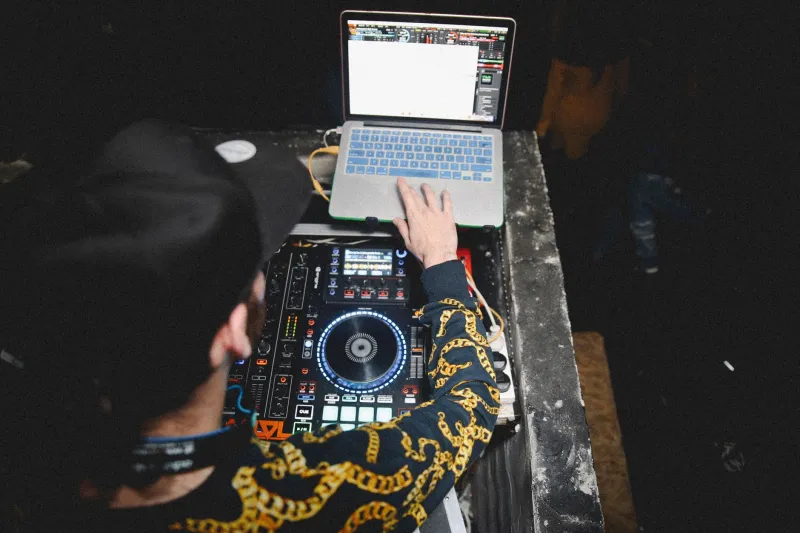
Streaming a DJ set isn't as simple as pointing a phone at your mixer, though plenty of people start exactly that way. The DJs who are building real traction tend to invest in a few key areas: decent audio routing (getting your mix into your streaming software cleanly is non-negotiable), at least one camera angle that shows your hands and gear, and consistent scheduling.
That last point matters more than most people expect. Twitch in particular rewards consistency — the algorithm responds to regular broadcast schedules, and so do human beings. Mara streams every Friday at 9 PM Mountain Time without exception. Korrupt goes live Tuesday and Saturday. Their audiences have built habits around those streams the same way people used to plan their nights around a favorite DJ's residency.
For audio, many streamers use a dedicated interface with a secondary output routed into their streaming PC, bypassing the mix-destroying compression that comes from just plugging headphones into a phone. Tools like OBS Studio handle the video side for free, while platforms like Streamlabs add donation alerts and subscriber notifications that keep the energy interactive.
Copyright remains the elephant in the room. Twitch and TikTok both use automated content ID systems that will mute or flag streams playing major-label music. Some DJs have adapted by leaning into underground labels, promo pools, and white-label tracks. Others use DJ-specific streaming services like DJ.Studio or stream through platforms that have licensing agreements in place. It's an ongoing workaround, not a solved problem — and it's worth being honest about that.
The Limitations Are Real — But So Is the Ceiling
Streaming a career into existence isn't without its friction points. The income is often inconsistent early on, and building an audience takes months of showing up before the algorithm starts doing any of the heavy lifting. There's also the question of what streaming can and can't replicate: the physical energy of a room, the subwoofer pressure, the crowd feedback loop that makes great DJs great. Some skills genuinely only develop in front of a live audience.
And while festival bookings off the back of a Twitch following are real, they're still the exception. Most streaming DJs who want to grow into live events need to eventually bridge the two worlds — using their online platform to build leverage, then converting that into local and regional gigs.
But here's the thing: the traditional path had its own brutal limitations. Gatekeepers, geography, gender bias, genre bias, the cost of living in cities with actual club scenes. Streaming doesn't erase all of those, but it redistributes the power in ways that are genuinely exciting for anyone sitting outside the traditional system.
The crossfade between online and live isn't a compromise — for a lot of American DJs right now, it's the whole game plan.