Three Knobs, Infinite Power: What Your EQ Is Actually Telling You About Your DJ Game
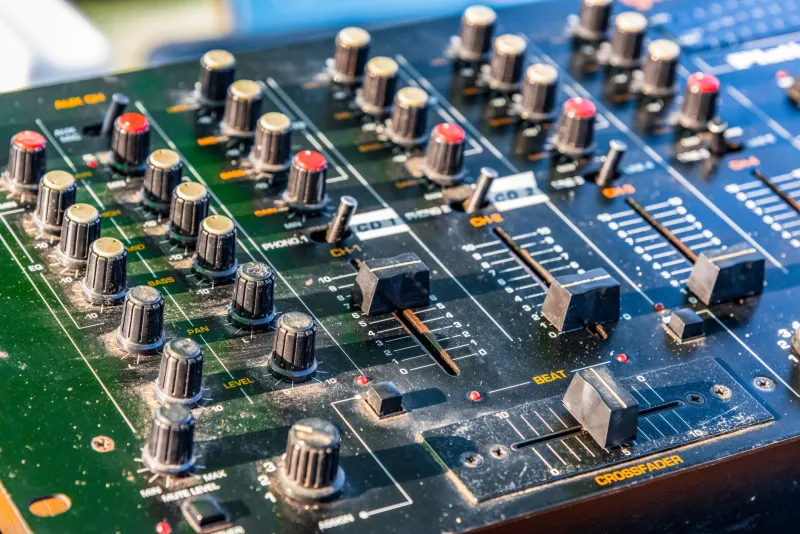
Walk into any club in America on a Saturday night and you'll see the same thing: a DJ hunched over a mixer, fingers dancing across effects pads, maybe throwing in a filter sweep or a stutter for the crowd. What you probably won't notice — what most people in that room never notice — is the quiet, constant work happening on those three unassuming knobs sitting just above the channel faders. The highs, the mids, the lows. The EQ.
It doesn't light up. It doesn't get TikTok clips. Nobody in the crowd is screaming because you rolled off the bass at just the right moment. But ask any working club DJ worth their salt what separates a set that flows from one that just kind of happens, and they'll point you there every time.
The Loudest Silence in the Room
Here's something that trips up a lot of newer DJs: EQ isn't really about adding things. More often than not, it's about taking things away.
The classic DJ mixer — think your Pioneer DJM-900 or Allen & Heath Xone series — gives you a three-band EQ: lows (bass and kick), mids (vocals, melodic elements, that warm middle ground), and highs (hi-hats, cymbals, air). Each band is a conversation between two tracks happening at the same time. When you're in the middle of a transition, you've got two songs fighting for the same frequency real estate. Your job isn't to let them both scream. It's to referee.
Cutting the low end on an incoming track while you blend it in is DJ 101 — most people learn that in their first month. What takes years to really internalize is understanding why that works, and how far you can push that logic across the whole frequency spectrum to shape how the crowd feels, not just what they hear.
Energy Is a Frequency
This is where EQ gets genuinely interesting and where a lot of DJs plateau. They learn the mechanics but never connect them to the emotional architecture of a set.
Low frequencies carry weight. Literally — bass frequencies are felt in the chest and gut before they're processed by the brain. When you pull the lows out of a track, you're not just cleaning up the mix; you're creating tension. You're telling the crowd, consciously or not, that something is coming. Hold that low-end cut long enough and the room starts to lean forward. Drop it back in — especially if you time it with a phrase break — and you've just created a moment that cost you nothing except a wrist turn.
Mids are trickier and more neglected. The midrange is where most of the musical identity of a track lives. Vocals, synth leads, guitar riffs — they all cluster in that 500Hz to 4kHz range. A lot of DJs barely touch the mid knob, treating it like a decoration. That's a mistake. Subtly dipping the mids on a track during a transition can make two songs that don't quite harmonically agree sound a lot more comfortable together. Boosting them, on the other hand, can push a vocal or a melodic hook to the front of the mix right when you need the crowd to lock in.
High frequencies are the shimmer and the air. They're what makes a mix feel open or claustrophobic. Rolling off the highs on an outgoing track as you bring a new one in is one of the smoothest ways to signal a handoff without the crowd even clocking the seam.
The Two Failure Modes
Here's the honest truth about how most DJs relate to their EQ: they're either ignoring it or abusing it.
The ignore camp is mostly beginners and hobbyists who are still focused on beatmatching and track selection. They set the EQ flat and leave it there. The mix works, technically. But it's flat in more ways than one. There's no dynamic shaping, no tension and release, no sense that someone is actively sculpting the energy of the room.
The abuse camp is actually more common among intermediate DJs who've learned just enough to be dangerous. They've watched a few YouTube tutorials, they know the low-cut trick, and now they're cranking knobs constantly — boosting the bass until it clips, cutting mids so aggressively that tracks sound hollow, sweeping the highs up and down like a nervous habit. The mix ends up feeling seasick. Restless. Like the DJ doesn't trust the music to do its job.
Both failure modes come from the same root problem: not really listening. Not to the technical output, but to how the music is actually landing.
Developing the Ear That Matters
Every production educator and experienced club DJ will tell you the same thing when you ask how to get better at EQ: stop looking at the mixer and start listening to the room.
That sounds obvious, but it's genuinely hard to do when you're also managing tempo, cue points, the next track in your head, and whatever the crowd is throwing at you. EQ decisions made by muscle memory — the kind that happen automatically because you've internalized the music — are almost always better than ones made by overthinking.
The practice that actually builds that instinct? Play records at home with your eyes closed. Seriously. Run transitions without watching the waveforms or the meters. Just listen to what's clashing, what's muddy, what's thin. Your hands will start to know where to go before your brain catches up.
Another underrated move: go back and listen to recordings of your own sets. Not to cringe at the mistakes, but to hear what the EQ was actually doing to the music. You'll catch yourself boosting things that didn't need it. You'll hear gaps where a simple mid cut would have made a transition invisible. It's uncomfortable, but it's the fastest feedback loop available.
The Crossfade Philosophy
There's a reason the EQ lives at the center of every serious mixer layout — it's not an accessory to the mix, it is the mix. Effects come and go, sync buttons spark debates, controller setups evolve every year. But the three-band EQ has been the backbone of DJ mixing for decades because it maps directly to how humans experience sound: physically, emotionally, spatially.
Mastering it isn't about learning a set of rules. It's about developing enough honest self-awareness to hear what your music needs in real time and having the discipline to give it that — even when what it needs is for you to leave things alone.
The best EQ move you'll ever make might be the one you don't make at all.